How ICON’s Wall System is Tested for the World’s Toughest Conditions
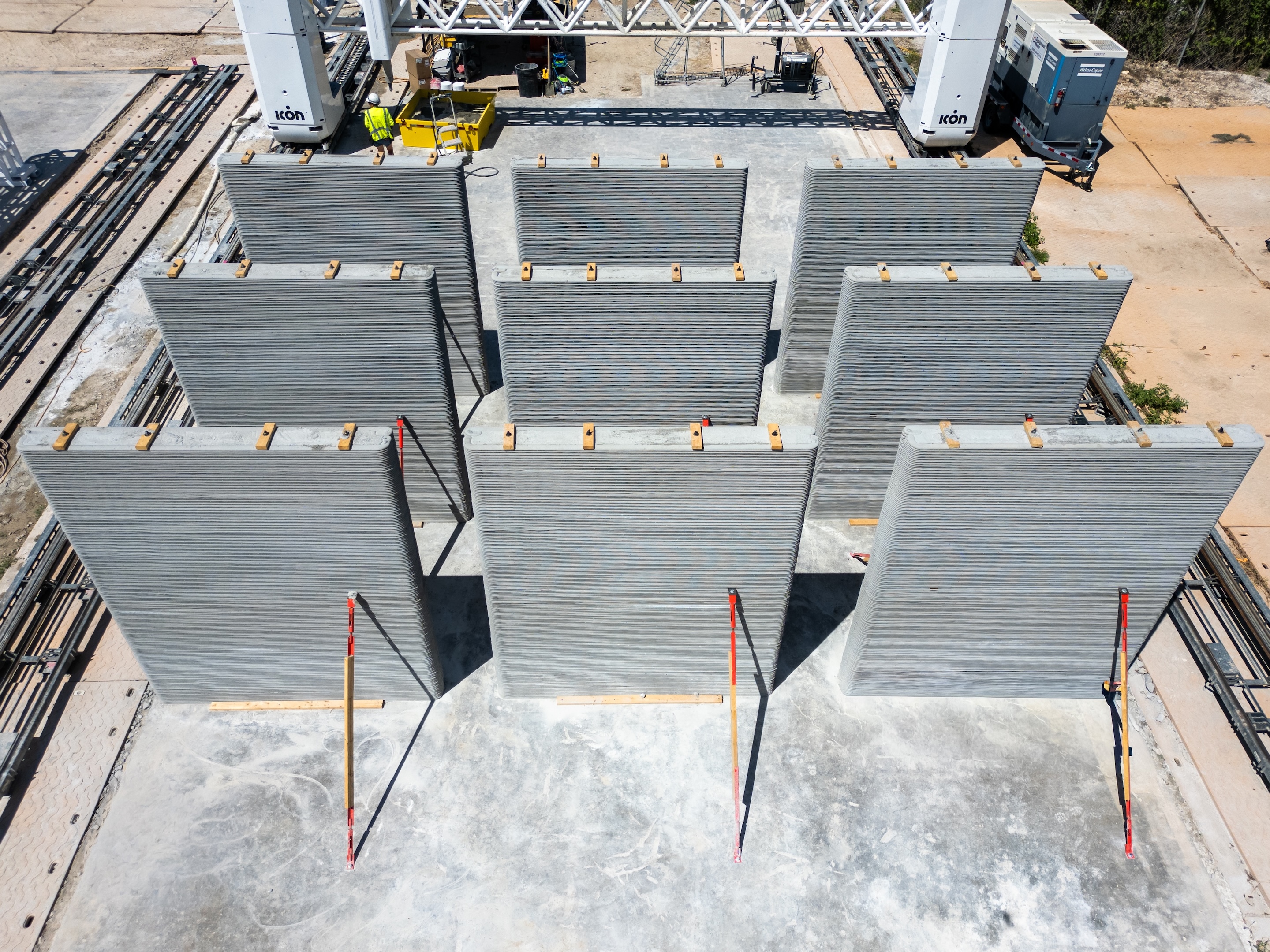
Over the past two years, ICON's building science and performance team has completed its most extensive structural testing expansion to date, covering fire resistance, hurricane and high-wind performance, seismic design, and material durability. Here is what the evidence shows.
Structures built with the ICON Wall System have been loaded to failure, subjected to hurricane-force winds, pelted with large-missile debris, burned for more than two and a half hours, and cycled through repeated freeze-thaw conditions. Every test was conducted by an independent, accredited laboratory. Every result is documented in third party test reports. Over the past two years, ICON's building and construction science team has completed an extensive expansion of that program, adding more than 60 full-scale structural specimen tests and more than 20 enclosure and small-scale tests to what was one of the most comprehensive third-party testing regimens in robotic construction.
This post builds on our 2024 update on fire resistance and hurricane performance. A lot has happened since then.
The Compliance Framework Behind Every ICON Structure
ICON's wall systems are approved through the Alternative Materials and Methods (AM&M) provisions built into the International Residential Code and International Building Code which is the pathway specifically designed to bring innovative construction technologies through rigorous third-party evaluation and into code compliance. ICC-ES, a subsidiary of the International Code Council, has independently reviewed ICON's testing and materials and issued an Engineering Service Report ESR-4652, which documents that the ICON Wall System complies with applicable code requirements under AC 509. Building officials across the United States recognize ICC-ES evaluation reports as demonstrating code compliance. ESR-4652 is maintained through annual renewals and semi-annual facility inspections.
For structural engineers, the Engineering Service Report provides the design values and documented load capacities needed to specify the ICON Wall System for site-specific conditions, from residential structures in low-seismic zones to high-wind coastal deployments requiring Miami-Dade High Velocity Hurricane Zone (HVHZ) approval.
Fire: Exceeding the 2-Hour Standard
ICON's printed load-bearing walls achieve a fire resistance rating that exceeds 2.5 hours in ASTM E119 testing, which is specified for design purposes as a 2-hour fire-rated assembly. Non-load-bearing interior walls achieve 117 minutes, specified as 90-minute rated assemblies. These are the documented performance levels as deployed in the field and reflect the same specifications that apply to every ICON Wall System.
The ASTM E119 test is the construction industry's benchmark for fire resistance: a controlled fire following a graded temperature curve, followed by water spray to simulate a fire hose, and under structural loading for load-bearing walls. Passing it means occupants have a substantially extended window for safe evacuation. It also directly affects insurance classification, design flexibility, and multi-story application.
Hurricanes and High Wind: Tested to Miami-Dade Standards
ICON's wall systems are tested and documented for compliance with Florida's HVHZ requirements — the standard developed in the wake of Hurricane Andrew that sets the highest bar for hurricane-resistant construction in the United States. The ICON Wall System meets HVHZ provisions for service-level wind loads up to 100 psf, consistent with the 175 mph design wind speed required for Miami-Dade County.
Because testing for 175 mph HVHZ conditions exceeds the design wind speed requirements in most U.S. jurisdictions outside Florida, the existing documentation base supports design submissions across a wide range of high-wind applications around the Gulf and Atlantic Coast. .
HVHZ compliance is supported by testing under the 2023 Florida Building Code Testing Application Standards:
TAS 202 / ASTM E330 establishes that the wall maintains air and water barrier integrity under sustained design wind loads without structural damage or envelope breach.
TAS 201 / ASTM E1886/E1996 tests debris impact resistance, specifically for large missile impact simulating wind-borne objects during hurricane conditions.
TAS 203 / ASTM E1886/E1996 goes a step further: cyclic pressure resistance testing is conducted on specimens that have already been impacted, validating that the wall maintains its protective function even after debris damage — across the full duration of a hurricane event.
ICON has also established a plan review process for projects in Miami-Dade County, with documented precedent from prior approvals to support future projects in Florida's demanding wind regions.
Structural Performance: A Complete Testing Program
The structural testing program behind ESR-4652 addresses every major load condition a wall system encounters in service.
Axial compression (ASTM E72) — Full-scale wall specimens are tested under vertical loading to validate design values for gravity loads from roof and floor systems, across different wall thicknesses and reinforcement configurations.
Out-of-plane flexure (ASTM E72) — Full-scale specimens are tested under third-point lateral loading to establish capacity for lateral wind loads and maximum span capabilities between horizontal and vertical supports.
In-plane shear (ASTM E72) — Full-scale specimens are tested under in-plane lateral load to establish racking capacity and shear design values for lateral load paths, including wind and seismic forces.
Cyclic loading (ASTM E1886/E1996) — Specialized testing under simulated high-wind load patterns evaluates the wall system's ability to maintain capacity across multiple wind loading cycles.
Wind-borne debris impact (ASTM E1886/E1996) — Large missile impact testing simulates hurricane debris conditions and validates compliance with Miami-Dade HVHZ requirements for debris impact resistance.
Material Testing: Understanding What FormCrete Does
The material performance of FormCrete, ICON's proprietary low-carbon concrete printing material, is characterized across five distinct test regimens.
Compressive strength (ASTM C39) establishes design strength values and characterizes directional strength properties relative to print orientation which is the foundation for all structural load capacity calculations.
Interlayer bond strength (ASTM C1583) determines the wall's ability to resist tensile and shear forces across layer boundaries, validating structural continuity in the layered construction at varying layer extrusion times.
Flexural strength (ASTM E518) determines resistance to flexural tensile forces across layer boundaries.
Freeze-thaw resistance (ASTM C666) confirms material performance and integrity in cold climates under repeated freezing and thawing cycles.
Shrinkage characterization (ASTM C157) informs control joint spacing requirements and predicts long-term dimensional changes in the wall system.
FormCrete also performs as a Class III vapor retarder, with a tested vapor permeance of 1.15 perm across a single printed shell at nominal 2.5-inch width (ASTM E96 Method A). Rain resistance is separately validated under ASTM E331.
Seismic Design: Coverage Across the Continental United States
For projects in Seismic Design Categories A and B, which covers most of the continental United States outside the West Coast and known seismic zones. ICON's printed wall systems can serve as the complete lateral-force-resisting system using the design values documented in ESR-4652.
For SDC C and higher, ICON has established a compliance pathway under ASCE 7-22 and ACI Code 318-19. In these applications, designated walls are designed as special reinforced concrete shear walls, with the printed geometry functioning as stay-in-place formwork while cast-in-place concrete and reinforcement provide the code-recognized seismic capacity.
What the Numbers Say
The ICON Wall System's performance across independent third-party testing is summarized below. All values are documented in ICC-ES ESR-4652.

Engineered for What's Next
The ICON Wall System is not a research prototype or a pilot program. It is a fully tested, code-compliant, commercially deployed wall assembly that can be utilized in residential communities, in U.S. military installations, and now available to builders through the Titan program, ICON's most advanced robotic construction platform. The testing program behind it represents one of the most comprehensive bodies of third-party structural evidence for any advanced construction system in the United States.
For architects, engineers, developers, and government partners evaluating ICON’s intelligent machines and autonomous systems for their next project, the documentation is available. The evaluation reports are published. The wall system has been built, loaded, impacted, burned, frozen, and tested to the point of failure. What these results show is a system engineered to endure.
ICON is the global leader in construction automation, developing robotics, intelligent software systems, and advanced materials that are changing the way the world builds on Earth and beyond.
.jpg)
.jpg)